And what happens to a 60-foot tree when it begins to lean over a Manhattan sidewalk where thousands of people cross every hour? You can’t just “cut it down.” A single misstep and you have shattered automobiles, broken brownstones or more severe injuries. Removal of trees in Manhattan is not a country yard job.
It is a highly technical and controlled exercise that needs accuracy, planning, and the use of the correct equipment to handle urban tree removals, rigging in tight spaces, and high-risk tree removals without affecting the urban setting.
Why Manhattan Tree Removal Is So Complex
In Manhattan, there are no trees planted in the open areas. Brownstones, apartment buildings, electricity wires, parked cars, and sidewalks are all around them. Some of the streets are so narrow that a normal truck can hardly pass through them, much less heavy machinery.
A typical tree removal service in Manhattan NYC involves dealing with:
- Limited drop zones with zero margin for error
- Pedestrian traffic that never fully stops
- Overhead utility lines and communication cables
- Fragile property structures like stoops, railings, and glass storefronts
You’re not just cutting wood you’re managing risk in a dense urban environment where every cut matters.
The Pre-Removal Assessment: Where Safety Starts
A risk assessment of the trees is carried out in detail before even a single branch is touched. This is where professionals and amateurs part ways.
Certified arborists examine:
- Mechanical soundness of the tree (decay, cracks, weak unions)
- Weight and lean angle.
- Nearness to structures and cities.
- The stability of compacted city soil.
In Manhattan, trees are limited by the size of their root systems because of cutouts on the sidewalk and underground utilities. This causes them to be more unsteady, particularly following storms or a heavy rain.
An appropriate determination will dictate whether a tree is to be cut in stages, rigged, or necessitate a crane-assisted tree cut.
Traffic Control and Site Preparation
You cannot take out a tree in Manhattan without the environment surrounding it. At this point, coordination is important.
Professional crews set up:
- Sidewalk barriers and fences.
- Stop-and-go road signs and cones.
- Co-ordination with city permits and NYC DOT laws.
- Spotters to check pedestrians and traffic.
In busy places, they can be removed early morning or at off-peak time to minimize exposure.
This is not merely a matter of convenience but about reducing risk to the populace and ensuring that the laws of the city are upheld.
Sectional Dismantling: The Only Way to Work in Tight Spaces
In Manhattan, trees rarely fall at one piece. Instead, we use sectional dismantling, a method where the tree is removed piece by piece from the top down.
Here’s how it works:
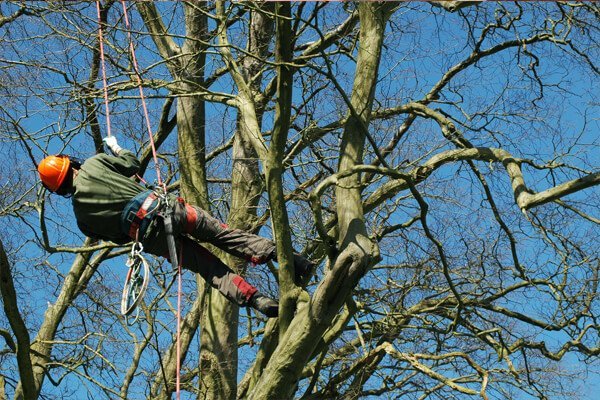
Climbers ascend using rope and harness systems or a bucket truck when access allows. They start by removing smaller branches, working their way down to larger limbs and eventually the trunk.
Each piece is carefully controlled using rigging systems, including:
- Lowering ropes
- Pulleys and friction devices
- Rigging blocks anchored high in the tree
This allows heavy sections to be lowered slowly and precisely into tight spaces without dropping or swinging into nearby structures.
In most of the positions in Manhattan, there is not even a free space where debris can fall freely. It all should be directed down.
Advanced Rigging Techniques for Urban Tree Removal
Generic rigging is not sufficient in Manhattan. Crews usually employ sophisticated ways of managing large parts in a safe way.
Negative rigging is popularly applied in the elimination of the heavy limbs over obstacles. The method regulates the force towards the ground and eliminates shock loading on the tree or rigging system.
There can also be speed line rigging where the branches can be transported horizontally over a site with no direct drop zone. It comes in handy particularly when operating in rooftops or fenced areas.
These methods are subject to experience. A wrong judge of weight or tension may cause failure or uncontrolled motion of equipment.
Crane-Assisted Tree Removal in Manhattan
When trees are too large or too dangerous to dismantle traditionally, a crane-assisted tree removal becomes necessary.
Cranes are used when:
- The tree is dead, brittle, or structurally compromised
- There is no safe climbing path
- Surrounding obstacles make rigging too risky
A crane operator works in coordination with the tree crew to lift large sections directly off the tree and move them to a designated landing zone.
This method reduces cutting time and minimizes risk, but it requires:
- Street closures
- Special permits
- Precise communication between the climber and crane operator
In Manhattan, where space is limited, crane work is often the safest and most efficient option.
Managing Debris in a No-Space Environment
Once sections are removed, the next challenge is handling debris without blocking the street or sidewalk.
Crews use:
- Wood chippers positioned strategically to process branches immediately
- Controlled stacking of logs in designated zones
- Rapid loading into trucks to keep the area clear
Timing is critical. In Manhattan, you can’t leave piles of debris sitting around. Everything must be removed quickly to restore normal flow.
Protecting Surrounding Property
Removal of trees in narrow urban areas is not just the removal of the tree but safeguarding around it.
- Crews go the extra mile by ensuring the following:
- Padding and plywood shielding to cover sidewalks and buildings.
- Locking up windows, railings and surrounding surfaces.
- The management of swing radius at the rigging process.
A minor branch is enough to create a major damage in the event it collides with glass or metal buildings. This is the reason why all movements are computed and regulated.
Emergency Tree Removal in Manhattan
Trees can become immediate hazards as a result of storms, high winds, and heavy snow. The emergency tree removal services in such a circumstance need to be quick.
The cases of emergencies tend to include:
- Leaning trees around buildings.
- Limb bones hanging in the street.
- Uprooted trees that prevent traffic.
It is even more risky since the tree is already unstable, and such jobs are risky. The crews should think fast on how to take away the safest way without causing further collapse.
In most of the situations, emergency removals are performed at night or on urgent situations, thus they need skilled people who can make quick and precise decisions
The Role of Certified Arborists and Safety Standards
Tree removal in Manhattan isn’t a DIY job. It requires trained professionals with proper certification and safety training.
Qualified crews follow standards set by:
- ISA (International Society of Arboriculture)
- ANSI Z133 safety guidelines
- OSHA safety regulations
Every crew member understands how to manage fall protection, cutting techniques, and rigging loads safely.
This level of expertise is what prevents accidents in one of the most challenging work environments in the country.
Why Experience Matters in Manhattan Tree Removal
Not all tree companies will be able to cope with Manhattan jobs. Suburban tree working experience does not necessarily transfer to urban conditions.
In Manhattan you need a team that realizes:
- Working in tight areas with no drop zones.
- Co-ordinating with city permits and traffic control.
- Safety of using advanced rigging and crane systems.
Errors here are no little things, they are expensive and harmful.
Conclusion
Cutting down a huge tree in Manhattan is not only a service it is a well-thought-out business that involves technical rigging, city safety precautions, and experience in high-risk scenarios. Starting with detailed check-ups and traffic management to sectional deconstructing, crane raises, and so on, all measures are intended to ensure the safety of people, infrastructure, and the city as a whole.
When you are handling a tree in a tight spot in Manhattan whether it is not stable, unmanageable or even storm-torn up you should get experts who know precisely how to approach it. To be safe, accurate, and better under control of tree removal in Manhattan NYC, rely on the professional team of NYC Tree Cutting.